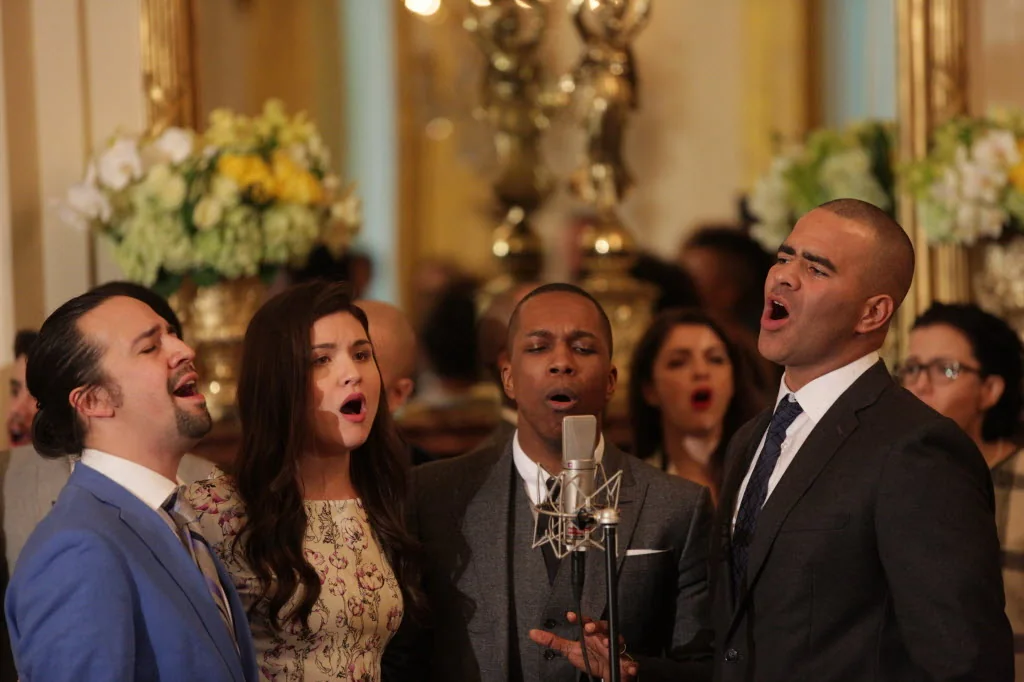
Take Hamilton out of the Richard Rodgers Theatre. Take away David Korins’s brick, timber, and turntables. Put the cast in the East Room of the White House with American history staring back at them from the walls. In March 2016, the cast performed in that room for the Obamas and visiting students. The building did some of the work the set usually does. It gave the actors a piece of national history to stand inside and argue with.
That is where I would start the 2010s. After decades of asking whether an audience would follow a story from one medium to another, musicals were asking something more pointed. Who was going to tell the story this time? A founding father could rap. A graphic memoir could give Broadway three versions of the same girl. A movie could take a traffic jam in Los Angeles and turn it into a musical number without leaving the freeway.

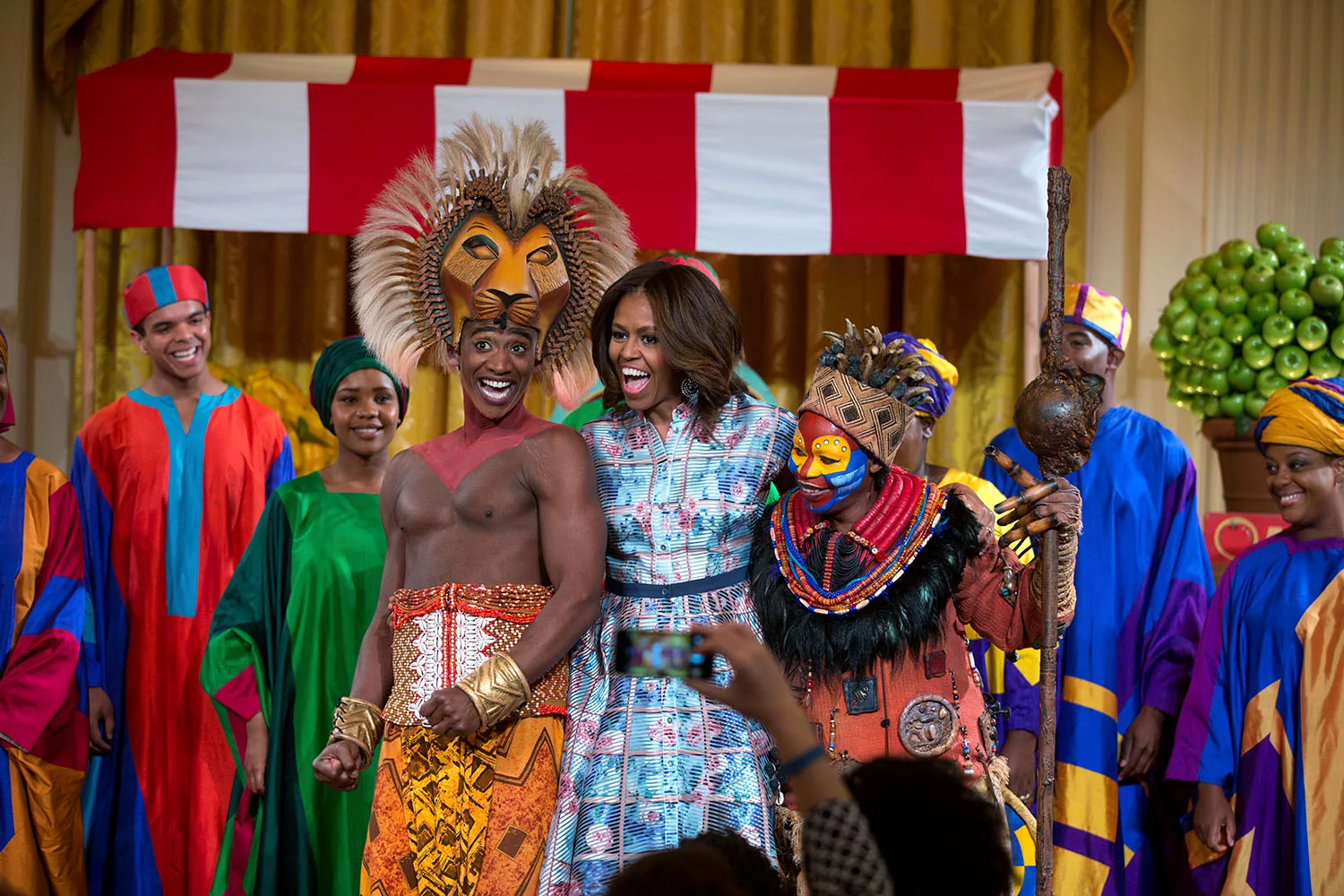
Harp369 · CC BY-SA 4.0 · Resized and cropped for display · Source

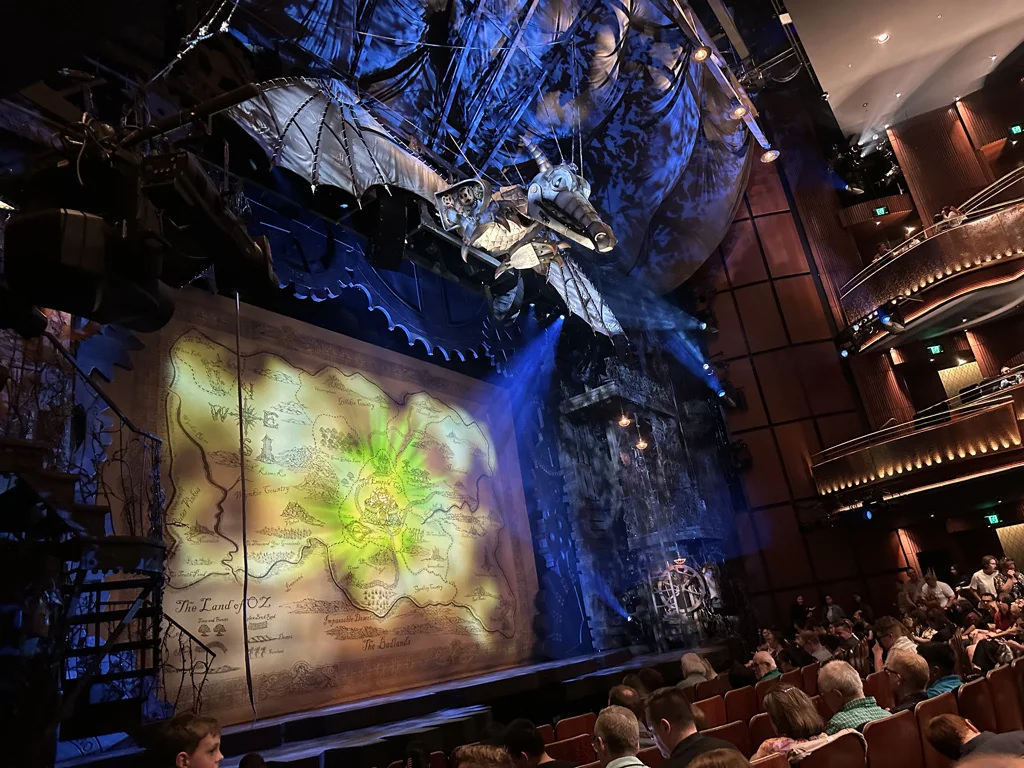
Reinhard Liess · CC BY-SA 2.0 · Resized and cropped for display · Source

Lionsgate Entertainment · CC BY-SA 4.0 · Resized and cropped for display · Source
The artists who changed the frame
Lin-Manuel Miranda takes the neighborhood into the history book
In In the Heights, Miranda and Quiara Alegría Hudes use the sounds of a neighborhood to tell us who lives there, what each person wants, and how they belong to one another. In Hamilton, Miranda brings that attention to musical language to a founding story usually told in a very different register. The characters argue in rap because the form gives them the speed and precision to fight over an idea in public. He brings a Broadway audience a historical argument it can hear in the rhythm before it has sorted out all the facts.
Lisa Kron and Jeanine Tesori turn a graphic memoir into a live memory
Alison Bechdel can place a childhood scene next to an adult observation on the page. Kron and Tesori needed a theatrical equivalent. The musical can let an adult Alison watch two younger versions of herself, then let a song land with the younger character who does not yet have the words to explain what she sees. That change in point of view is part of the adaptation’s structure. It also tells a designer when a room needs a specific detail and when a performer can call it into being.
Anaïs Mitchell and Rachel Chavkin make a folk score work in a room
Mitchell’s Hadestown began its life outside the Broadway production that most audiences know. In Chavkin’s staging, the band and the narrating presence of Hermes help establish the room before the machinery starts to change it. Rachel Hauck’s design can then alter the space and let that alteration become part of the story. The collaboration shows what happens when a musical built around the act of telling becomes a production built around the act of moving through a world.
Landmark productions
Hamilton (2015): Lin-Manuel Miranda and the founding story
Miranda’s score puts argument into the rhythms of the music. The cabinet battles make political debate into a performance with an opponent and an audience. Thomas Kail’s direction and Andy Blankenbuehler’s choreography carry that idea into the room. Korins’s design can keep the ensemble present as witnesses while the story moves from a public argument into a marriage. A complete new location for every scene would slow down the exchange. The shared structure lets the actors change the meaning of the room faster than scenery could change the room itself.
The White House visit made the issue of access explicit. Obama talked about students using the musical to engage with the founding. There is a difference between a civics conversation organized around the show and the show’s own complicated view of ambition. That difference is worth keeping. The event tells us how a political institution received the musical, while the performance gives us room to hear its tensions.
Eight months after the White House visit, the election put the production in a different political room. At a November performance attended by Vice President-elect Mike Pence, Brandon Victor Dixon addressed him from the stage on behalf of the cast. At the White House, the administration had invited the artists to take part in a civic conversation. At the theatre, the artists initiated the conversation. In both cases, what the cast looked and sounded like mattered to the public meaning of the event.
Fun Home (2015): Lisa Kron, Jeanine Tesori, and Alison Bechdel’s rooms
Fun Home reached Broadway in 2015, the same year the Supreme Court ruled in Obergefell v. Hodges that same-sex couples had a constitutional right to marry. The musical had a development history of its own, and its story is about memory, sexuality, and a particular family. The timing gives us a way to talk about what queer stories were reaching national audiences while legal recognition and public visibility were changing.
David Zinn’s design at Circle in the Square can bring a domestic object into focus without asking it to stand for every home. Alison is remembering specific rooms and specific people. The designer’s job is to decide which detail carries that memory and what can be left for the performer to supply.
Kron and Tesori find a musical form for three Alisons who can be in the same room without occupying the same time. “Ring of Keys” turns a brief encounter into a moment of recognition. It needs room for a child to notice a detail and an audience to understand what that notice means. Coming from Hamilton to Fun Home, the scale of the action changes. The stakes of who gets to recognize themselves in the story are still there.
Hadestown (2019): Anaïs Mitchell, Rachel Chavkin, and the work below ground
Hadestown brings a different political question into a familiar story. The underworld is also a place where people work. The journey down makes the geography of that bargain physical. Rachel Hauck’s scenic transformation works because the audience has already learned how to read the room upstairs. When the world changes, we know what has been taken away.
Mitchell’s musical gives us a boss who can offer work and security while making the workers give up more than they bargained for. Chavkin and Hauck make that bargain legible through the rooms above and below ground. There is a useful comparison with the 2012 Newsies, which brought Disney’s film back as a Broadway show about young workers organizing. Tobin Ost’s structures give the newsboys height, levels, and places to assemble. One production makes solidarity visible in the city. The other asks what it takes for a worker to leave a place designed to keep them there.
La La Land (2016): Damien Chazelle and the Los Angeles musical
La La Land and The Greatest Showman also ask audiences to recognize earlier forms. La La Land uses Los Angeles streets, freeways, and landmarks as places where ordinary life can briefly give way to the camera’s musical imagination. Its nostalgia is bound up with a question about whose story Hollywood remembers and how it retells the history of jazz.
David Wasco’s production design and Sandy Reynolds-Wasco’s set decoration help make the everyday city usable as musical space. In the freeway opening, the lanes are the floor pattern and the car roofs become platforms. The number is built around where a camera can travel through that geography. The film’s final stretch then changes the rules. We see an imagined version of the relationship and the city, and the scenery has permission to look like something made for a soundstage. The design changes because the story is showing us a life that never happened.
The Greatest Showman (2017): Michael Gracey and the pop anthem
The Greatest Showman makes its appeal through a different kind of spectacle. The scale of the ensemble and the contemporary pop sound invite audiences to identify with a story about belonging. The film’s treatment of Barnum is a useful point of comparison with Hamilton. Both turn a historical figure into a musical protagonist. Each makes choices about whose point of view it takes, whose experience it compresses, and what the music encourages an audience to feel.
“This Is Me” can leave the film and still work as a performance. Keala Settle’s voice carries the number even when an audience sees it as a clip rather than as part of the entire story. That circulation matters. It can make a song’s argument about belonging the thing audiences remember most. It can also leave the historical question behind. Who gets to speak inside Barnum’s show, and who gets to tell the story of Barnum himself?
How the decade directed the audience’s eye
The move from Hamilton to Fun Home to La La Land gives us three ways to decide what the audience sees. A turntable changes the relationship between bodies on a proscenium stage. An actor in a theatre in the round has to make a small recognition read from several directions. A camera can carry the audience right up to a dancer on a freeway and turn before the audience has finished studying the wider space. Those are three different design problems, even when the score is doing the same basic work of carrying us into someone’s point of view.
The audience outside the room
These musicals reached people in more forms than a single performance or screening. The White House video is one example. It lets someone see how a Broadway number works in a civic space, even if they have never seen the production. It also raises a design question. How much of a musical world can travel through a song, a close-up, or a few minutes of footage? The answer depends on what the original performance taught us to see.
Frequently asked questions
Why include the White House performance?
It documents a moment when a Broadway production became part of a public discussion about American history and access to the arts.
Does the 2015 marriage ruling explain Fun Home?
The ruling and Broadway opening belong to the same year. The connection is cultural context. The musical developed independently from Alison Bechdel’s memoir.
How do the film musicals connect to the Broadway examples?
Each reworks a familiar history or form. Broadway does it through performers sharing a room with an audience. Film can use framing, locations, and editing to change what we see and when we see it.
Why include Newsies and Hadestown together?
Both make labor part of the story and use scenery to show how people organize. Newsies builds a city the workers can climb and occupy. Hadestown gives us a workplace designed to keep workers underground.
Why did Hamilton work in such different rooms?
The score, performers, and choreography carry much of the story. At the White House those elements could work without the Broadway scenery, while the setting gave the performance another layer of meaning.
Sources and further reading
- White House archive of President Obama’s 2016 Hamilton remarks
- Michelle Obama’s remarks at the student workshop
- U.S. Supreme Court opinion in Obergefell v. Hodges
- White House performance recording and captions
- Hamilton production credits
- Fun Home production credits
- Hadestown production credits
- Newsies Broadway production credits
- Academy credits for La La Land’s production design
- 20th Century Studios credits and performance clips for The Greatest Showman
- Brandon Victor Dixon discusses the November 2016 address