In April 2001, Broadway opened The Producers, a hit musical based on a film about making a Broadway flop. A year later, Chicago went in the other direction. Rob Marshall took a Broadway musical about murder and publicity and used the camera to make the characters’ fantasies look like vaudeville acts. The two projects show how freely the musical was moving between Broadway and Hollywood by the beginning of the decade.
Between those releases came September 11. In November 2001, New York launched a campaign to bring visitors back. One vignette put Barbara Walters on Broadway. The city was using the act of going to the theatre as evidence that New York was open. The Producers had already opened by then, so the recovery did not start the adaptation trend. It does explain why a Broadway night out mattered to more people than the producers of an individual show.

John Mathew Smith / www.celebrity-photos.com · CC BY-SA 2.0 · Resized and cropped for display · Source

Andreas Praefcke · CC BY 3.0 · Resized and cropped for display · Source

Rob Rich / The Drama League · CC BY 2.0 · Resized and cropped for display · Source
The people who made the exchange work
Mel Brooks and Susan Stroman turn a film into a live joke
Brooks had already written and directed the film. For Broadway he became the songwriter, too, working with Thomas Meehan on the book. Stroman understood that the audience had to believe in the show inside the show. If the choreography merely winked at the joke, there would be nothing at stake. She gave the deliberately tasteless material a precise, convincing Broadway form. It is possible to laugh at a musical number and be impressed by the way it is built in the same instant.
Marc Shaiman and Scott Wittman make the dance show sing
John Waters gave Hairspray a world of local television, adolescent obsession, and racial exclusion. Shaiman and Wittman had to make it possible for the characters to sing from inside that world. They could draw on the sound of a televised dance show and then turn that sound into something the people excluded from the show could claim. The score gives the room an argument the dancing can finish.
Rob Marshall and Catherine Martin solve different camera problems
Marshall brought a choreographer’s eye to Chicago. His approach turns a trial, a press conference, and the management of celebrity into numbers because his characters are already thinking about how to perform for an audience. Catherine Martin’s work with Baz Luhrmann on Moulin Rouge! starts from a different premise. The film’s entire world is already heightened enough to sing. Her design gives the camera places to plunge into, pull away from, and cut across. The two films are useful together because they arrived close to one another without agreeing on what the genre had to look like.
Landmark productions
The Producers (2001): Mel Brooks turns the business into the joke
Brooks supplied the songs and wrote the book with Thomas Meehan. Susan Stroman directed and choreographed the Broadway production. That combination matters because the joke needs a show inside the show that can actually work. The audience has to recognize the polish of a Broadway production while watching characters attempt to make something so offensive it will close immediately.
The film had already found a comic premise audiences understood. The musical could go further by giving that premise a real Broadway orchestra, a chorus, and an audience sharing the same room. The thing the characters are trying to manipulate is the very thing the paying audience has come to see.
Hairspray (2002): John Waters, Marc Shaiman, and Scott Wittman
Where Brooks adapted his own work, Hairspray handed John Waters’s film to a new team. Shaiman and Wittman wrote a score that could move between the sound of the TV dance show and the lives of the people trying to get onto it. Jack O’Brien directed, Jerry Mitchell choreographed, and David Rockwell designed the scenery. The adaptation carried the camp of the film into a different scale of performance.
The dance-show studio in Hairspray is a useful scenic problem. It has a public face the audience can recognize immediately. It also needs to show us how people are selected, kept apart, or brought together. Who gets a spot in front of the camera becomes a physical question about who has access to the room. The story is set in 1960s Baltimore, but the 2000s stage adaptation asked its own audience to watch what happens when a supposedly cheerful piece of popular culture is used to enforce exclusion.
Moulin Rouge! (2001): Baz Luhrmann and Catherine Martin build for the cut
Moulin Rouge! went the other way in 2001, putting theatrical scale and pop songs inside a film that moves at the speed of a cut. Catherine Martin’s design gives the camera a world it can rush into, pull apart, or compress. The songs are often familiar before the characters sing them. That recognition lets the film get to the emotional turn quickly.
Chicago (2002): Rob Marshall finds the camera’s vaudeville
Rob Marshall’s Chicago (2002) makes the transition to a song do a different job. A character’s circumstances can become a vaudeville turn, and the way the number is framed tells us something about who controls the story. The camera and editing let us shift between a room and someone’s performance of what happened there. The film’s 2003 Best Picture win and its art direction and set decoration award put that translation in front of an audience far beyond Broadway.
Compare the press conference with “We Both Reached for the Gun.” The musical framing lets the reporters and Roxie become puppets in Billy Flynn’s act. It is a joke about the press, and it makes an argument about how a public story is manufactured. Production designer John Myhre and set decorator Gordon Sim give the fantasy somewhere specific to happen. The 2003 awards themselves took place just after the United States went to war in Iraq. The Academy considered postponing and pared back the red carpet. That belongs to the film’s reception, a striking example of Hollywood deciding how to present spectacle at a particular political moment.
Two kinds of spectacle: Mamma Mia! and Wicked
Judy Craymer and Catherine Johnson built Mamma Mia! around songs audiences already knew from ABBA. Mark Thompson’s Broadway production design gives those songs a place and a set of relationships. A familiar track can turn into a mother’s memory or a daughter’s attempt to understand her family. The story gives the song a different job. That model could travel from pop recording to stage and then to a movie audience.
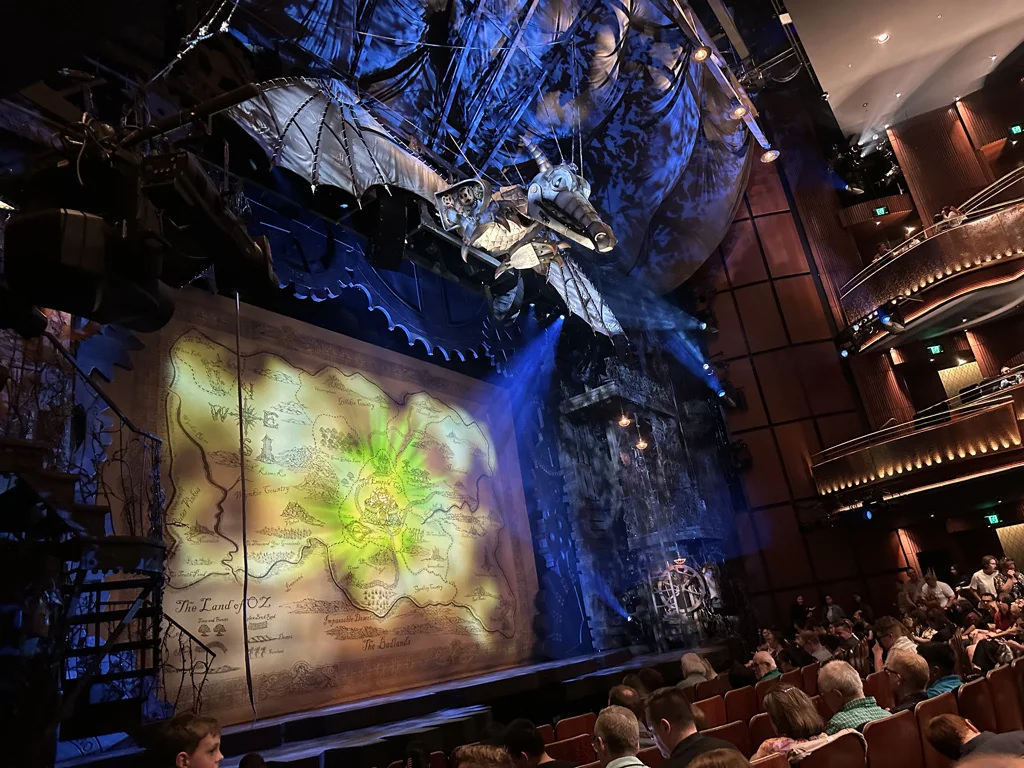
Wicked starts with another kind of recognition. Winnie Holzman and Stephen Schwartz invite the audience into a world it knows and then show how a person becomes its villain. Eugene Lee’s gears and clockwork give that world a physical language. They make Oz feel assembled and operated. That makes sense for a musical in which power depends partly on who controls the spectacle and the story people hear about it.
In the Heights (2008): Lin-Manuel Miranda and Quiara Alegría Hudes turn uptown
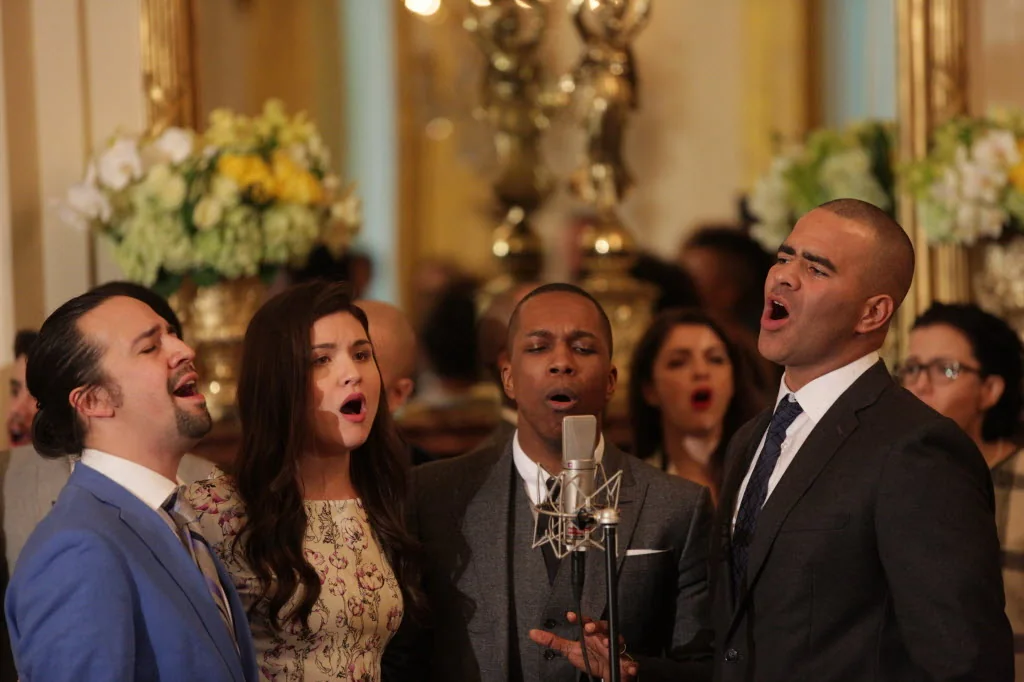
Near the end of the decade, In the Heights put Washington Heights at the center of a Broadway musical. Anna Louizos’s storefronts and street give the neighborhood a place to gather. When the power goes out, we already know the street well enough to feel the change. It is also a useful bridge to the next installment. Years before Hamilton, Miranda and Hudes were testing whose language, music, and neighborhood Broadway would put in the middle of the room.
What moves when the story changes medium?
Here is a useful way to compare the decade’s shows. In Hairspray, mark who is allowed in front of the camera and who has to wait outside the frame. In Chicago, mark who is creating the image that the reporters see. Then look at Moulin Rouge!, where the camera can put you inside someone’s fantasy before you have worked out the geography. Each example uses a frame to decide who gets the audience’s attention.
For a stage designer, the equivalent of a cut can be an entrance, a change of level, or an ensemble clearing the center of the room. For a film designer, a set may only need to contain the pieces the camera can see. Following the movement between those two sets of tools is more revealing than judging a stage adaptation by how much it looks like the film.
Who gets to keep working?
By the end of the decade, the Great Recession raised a different political question about the performing arts. The 2009 recovery law provided $50 million to the NEA for job preservation in the nonprofit arts. That program addressed a different part of the industry from a commercial Broadway run. Both matter to the people who build and perform musicals, many of whom work across commercial productions and nonprofit institutions.
There is a useful contrast between the bookends of the decade. After September 11, a city campaign asked audiences to return. In 2009, federal recovery funding helped nonprofit organizations keep people employed. In between, stage and screen kept exchanging material. For designers, each transfer raised a practical question. What does a story need to borrow from its source, and what does the new medium let us do that the source could never do?
Frequently asked questions
Was the stage adaptation trend a response to September 11?
It was already underway. The Producers opened before the attacks. New York’s later tourism campaign shows how the city drew on Broadway during the recovery.
What makes Chicago work as a movie musical?
The film uses framing and editing to move between events and the characters’ theatrical versions of those events. Those shifts do much of the storytelling.
Did the 2009 recovery grant program target commercial Broadway?
The NEA recovery funds discussed here were directed toward preserving jobs in the nonprofit arts sector.
What is a jukebox musical?
It builds a stage story around existing songs. Mamma Mia! uses the ABBA catalog to tell a story about characters other than the band.
How did the 2000s build on the 1980s installment?
The earlier film Hairspray became a Broadway musical in 2002. Chicago ran the exchange in the opposite direction, carrying a Broadway score and a theatrical vocabulary into a movie built around framing and editing.
Sources and further reading
- NYC archive on the November 2001 tourism campaign
- Miramax’s Chicago film and clips
- Academy of Motion Picture Arts and Sciences on the 2003 awards
- NEA Recovery Act research note
- The Producers opening date and credits
- Hairspray Broadway production credits
- Mamma Mia! Broadway production credits
- Wicked Broadway production credits
- In the Heights Broadway production credits